
Product Categories
PRODUCT CATEGORYContact Us
CONTACT USMobile phone:+86-15395152932
mail:[email protected]
Address:Electronic Information Industrial Park, Shunyi District, Beijing City
Automobile rear axle production line
Location:Home >> PRODUCTS >> Automobile rear axle production line
Automobile rear axle production line
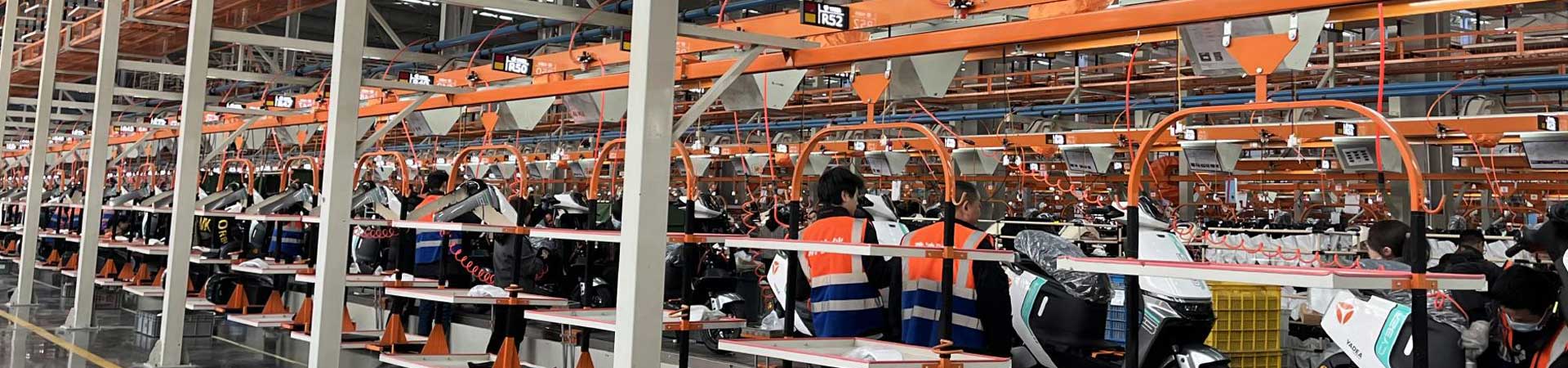
This circular closed-loop production system shown in the photo is a dedicated assembly solution for ...
Details
This circular closed-loop production system shown in the photo is a dedicated assembly solution for drum-brake rear axles used on light-duty vehicles, including micro-vans, mini trucks and small commercial vehicles. Drum-brake rear axles are high-volume, cost-sensitive chassis assemblies. Their core performance requirements cover load bearing capability, differential gear meshing quality, drum brake stability, half-shaft concentricity and sealing integrity. Unlike heavy truck axles designed for extreme heavy loads or independent suspension axles fitted on passenger cars, this series of rear axles prioritizes mass production feasibility, spare part interchangeability and low maintenance expenses over ultra-high individual performance. Tiny deviations during assembly — inconsistent bolt torque, positioning offset or brake drum misalignment — may trigger downstream quality issues: abnormal gear noise, brake pulling, oil leakage and premature component wear. This closed-loop trolley layout is engineered specifically to solve these mass-production challenges for light vehicle rear axle assembly.
Production Line General Description
The system adopts a ground-mounted circular track trolley conveying architecture. The complete workflow spans subassembly preparation, main line assembly, brake pipeline installation, inline sampling inspection and automatic empty fixture return circulation. A set of twelve mobile tooling trolleys runs continuously on the ring track. Each trolley is equipped with casters and adjustable positioning brackets, tailor-made to match the reference datum of drum-brake axle housings. These supports lock multiple datum points of the rear axle assembly and can accommodate multiple similar axle housing variants. While trolleys move along the track, stable positioning is maintained to prevent shifting and vibration during workpiece transfer. This creates reliable positioning foundation for bearing press-fitting, torque fastening and brake drum installation.
Pneumatic lifting balancers are deployed at designated stations to lift and mount heavy brake drums onto the axle reducer. Compared with manual hoisting operations, this lifting equipment eliminates collision scratches on brake drum friction surfaces and axle flange faces, and ensures identical workpiece placement posture for every axle unit. Once the rear axle housing is in place, pneumatic clamping cylinders secure the housing synchronously. Critical coaxiality between brake drum and half shaft can be controlled within 0.1mm, which effectively prevents uneven wear on brake shoes.
After positioning and preliminary assembly, workpieces travel to the intermediate quality checkpoint. Inspectors use dial gauges and laser displacement sensors to sample key assembly parameters: axle journal runout, gear backlash, brake drum end-face runout and flatness of sealing surfaces. Measurement data is streamed to electronic display boards on site. Red-green status lights give straightforward pass or fail indication. Any non-compliant assemblies will be diverted to a rework station for disassembly and adjustment, stopping defective units from flowing to later processes.
The workshop layout is partitioned by function. The central circular loop handles core final assembly tasks, while side workbenches are reserved for pre-assembling sub-components such as differential carriers, brake shoe modules and brake pipe harnesses. Each workstation carries out fixed operation tasks including servo torque tightening, brake pipe routing, oil seal fitting and accessory mounting. After finished rear axles are offloaded, empty tooling trolleys continue along the closed loop back to the feeding station to receive new raw axle housings. By swapping modular positioning supports on trolleys, the production line can quickly switch among different rear axle specifications. Optimized takt time enables balanced mass assembly, fully meeting high-volume manufacturing demands for low-cost light-duty drum brake rear axles.
Main Assembly Workflow of Rear Axle Assembly Line
- Sub-component Pre-assembly Complete pre-assembly of differential carrier, gear sets, brake shoe assemblies, oil seals and pipe fittings at side offline stations.
- Axle Housing Loading & Datum Positioning Place axle housing onto circulating trolley; pneumatic supports clamp and fix the workpiece.
- Differential & Half Shaft Mounting Install differential assembly and half shafts; servo press carries out precision press-fitting of bearings and oil seals.
- Brake Module Installation Use pneumatic balancer to lift brake drums and assemble brake related parts onto axle housing.
- Servo Torque Fastening & Pipeline Connection Tighten all flange and housing bolts via servo torque guns; route and connect brake pipelines.
- Inline Dimensional Sampling Check Detect journal runout, gear meshing clearance and brake drum end runout; store inspection records.
- Sealing & Leakage Test Run air tightness testing to verify oil seal sealing performance and eliminate leakage risks.
- Final Audit & Offloading Carry out final visual inspection and data review. Qualified rear axles are unloaded; empty trolleys circulate back.
Core Technical Features
- Closed-Loop Circular Trolley Conveying Ring track design enables automatic return of empty tooling trolleys, streamlining material flow and saving workshop floor area.
- Modular Fixture for Mixed-Model Production Quick-change positioning supports realize fast model switching, allowing multiple rear axle variants to be produced on one single assembly line.
- Precision Assembly & Poka-Yoke Error Prevention Pneumatic clamping, servo tightening and inline dimensional inspection stabilize assembly quality and reduce human errors.
- Digital Full Lifecycle Traceability MES system captures torque, press-fit and inspection data of each rear axle, realizing end-to-end assembly traceability.
Application Scope
- Microvan rear axle mass assembly
- Mini-truck light-duty rear axle production
- Light commercial vehicle drum brake rear axle manufacturing
Automobile rear axle production lineQuote----Automobile rear axle production lineFor the latest case images, please contact us for more specific information