
Product Categories
PRODUCT CATEGORYContact Us
CONTACT USMobile phone:+86-15395152932
mail:[email protected]
Address:Electronic Information Industrial Park, Shunyi District, Beijing City
(E-Trike)Electric Tricycle assembly Line
Location:Home >> PRODUCTS >> (E-Trike)Electric Tricycle assembly Line
(E-Trike)Electric Tricycle assembly Line
Electric‑tricycle Assembly Line Process The picture shows the final‑assembly line for enclosed‑cabi...
Details
Electric‑tricycle Assembly Line Process
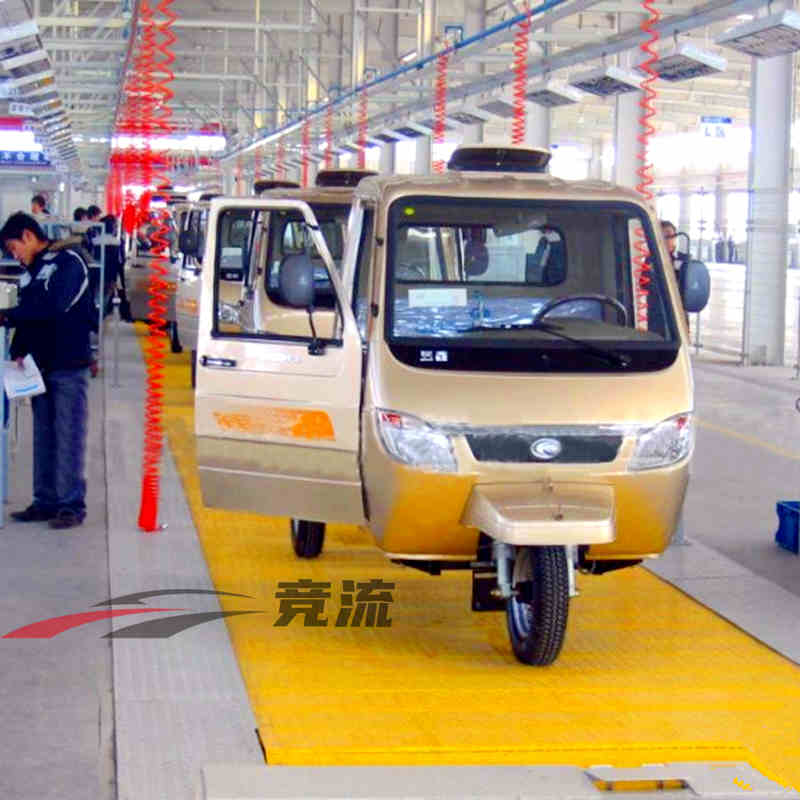
The picture shows the final‑assembly line for enclosed‑cabin electric tricycles. It adopts a floor‑mounted slat conveyor main line. Vehicle frames advance synchronously with slat tooling. Assembly stations are arranged on both sides. Pneumatic spring coiled hoses are installed overhead to supply compressed air for each station and enable parallel multi‑station assembly. The production line supports mixed‑model manufacturing of cargo‑carrying and passenger‑carrying electric tricycles.
When frames are conveyed into position by the slat conveyor, front‑axle assemblies, front shock absorbers and front‑wheel steering mechanisms are fitted and fastened. Work‑pieces move onward for rear‑drive‑axle assembly, where motors, differentials and suspension springs are mounted together with rear‑wheel groups. Afterwards, cabin shells are hoisted and bolted onto main frames. Operators fit door assemblies, windows, rear‑view mirrors, windscreen wipers, instrument panels and steering‑wheel control mechanisms.
After frame and cabin assembly is completed, units enter electrical assembly stations. Vehicle wiring harnesses are routed; controllers and power connectors are installed, and battery packs are mounted. Power circuits, light signals, horns and instrument systems are wired. The brake system components and brake pipelines are pre-assembled on the chassis; at this stage, technicians complete system bleeding and adjust hand‑brake and foot‑brake travel. Subsequent operations include seat installation, exterior‑part fitting and decal application.
Fully‑assembled tricycles proceed to the vehicle‑testing station. Power‑on inspection covers steering function, light signals, brake performance, motor driving status and whole‑vehicle insulation. Non‑conforming tricycles are taken off‑line to rework areas for troubleshooting of mechanical assembly and electrical wiring faults. Passing tricycles go through final visual inspection for paint finish and fastener torque, and assembly residues are cleared. Finished vehicles are off‑loaded, re‑checked and charged before warehousing.
This electric‑tricycle assembly line uses floor‑mounted slat conveyors as main carriers to transport tricycles of different weights. MES data acquisition records key‑station assembly information to realize full‑process traceability for each unit, enabling mixed‑flow assembly of multiple passenger‑type and cargo‑type electric tricycle models.
I. Electric tricycle structure
It is generally composed of the electric motor, transmission system, running gear, control and braking system and electrical parts. Compared with two-wheeled electric vehicles, electric tricycles have higher stability and are less likely to roll over during driving, especially on rough roads or when carrying loads. They have obvious advantages; they have strong carrying capacity and can be fitted with cabins or flat cargo beds, to carry passengers or load more goods. The operation is relatively simple and easier to get started.
II. Electric tricycle assembly line type
A chain plate conveyor line, roller conveyor line or suspended conveyor chain is usually used to convey the frame or body to each workstation at a fixed takt rhythm (such as 3 minutes per vehicle). The length of the assembly line is designed according to the production capacity (such as 500-1,000 vehicles per day). It is generally divided into pre-assembly area and main line assembly area, and is equipped with parts buffer area, tool storage area, inspection area and other functional zones.
III. Technological characteristics of electric tricycle assembly line
- Takt-based production: Each workstation completes the operation in a fixed takt time (such as 3 minutes/vehicle) and moves synchronously through the conveyor belt to avoid process backlog.
- Modular assembly: Pre-assembly of subassemblies (such as motor and rear axle assemblies) reduces the complexity of the main line and improves assembly efficiency and consistency.
- Error-proof design: Key plugs adopt special-shaped design for anti-misinsertion, bolts adopt different specifications for anti-misinstallation. Positioning tooling and fixtures are equipped to improve assembly accuracy.
- Automated assistance: Robot-assisted operations are applied in some links (such as automatic bolt tightening machines and automatic gluing machines) to reduce manual errors and improve production efficiency.
(E-Trike)Electric Tricycle assembly LineQuote----(E-Trike)Electric Tricycle assembly LineFor the latest case images, please contact us for more specific information